


Your lawn looks fine in May. By October, after three months of rain and a dog making daily laps of the garden, you’re left with muddy patches, bare soil, and a space nobody wants to sit in.
Artificial grass and natural turf each have a loyal following, and the right choice depends on how you use your garden, how much maintenance you want to do, and what you actually want your outdoor space to look like. We install both across Glasgow and Central Scotland, so we have no interest in pushing you either way. Here’s what the comparison actually looks like.
What’s the difference between artificial grass and turf?
These terms get used loosely, so it’s worth being clear. Turf refers to natural grass, either grown from seed or laid in rolls of pre-grown grass and soil. It’s real grass, rooted in the ground, and it grows, dies back in winter, and recovers with the seasons.
Artificial grass is a manufactured surface made from synthetic fibres (usually polyethylene) attached to a permeable backing. It’s laid on a prepared sub-base of compacted aggregate and sharp sand, with a weed membrane underneath. An infill material (typically sand or rubber crumb) is brushed into the fibres to keep them upright and support drainage. Once installed, it stays green regardless of weather, season, or foot traffic.
Both can look good in the right garden, and the right choice comes down to your specific outdoor space and how you use it.
How much maintenance does each one need?
Natural turf
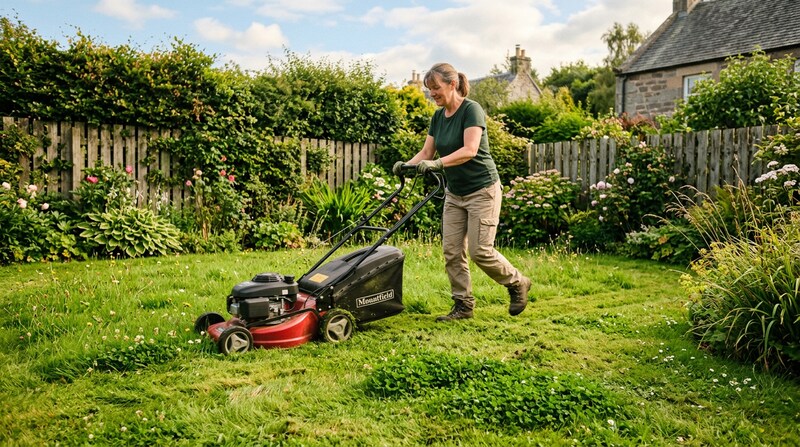
A well-kept lawn demands more time than most people expect. Mowing runs from April through October, usually once a week during the growing season. On top of that, turf needs watering during dry spells and feeding two or three times a year with a suitable fertiliser.
Aerating in autumn to relieve compaction and scarifying to remove thatch are jobs that often get skipped but make a real difference to lawn health. If moss gets established (a common problem in Scotland’s wet climate), you’ll need to treat it, rake it out, and overseed the affected areas.
Bare patches from dog traffic, heavy footfall, or winter waterlogging need attention every spring, and in Scottish gardens that’s a consistent pattern rather than an occasional issue. The work is manageable, but it is an ongoing time commitment across most of the year.
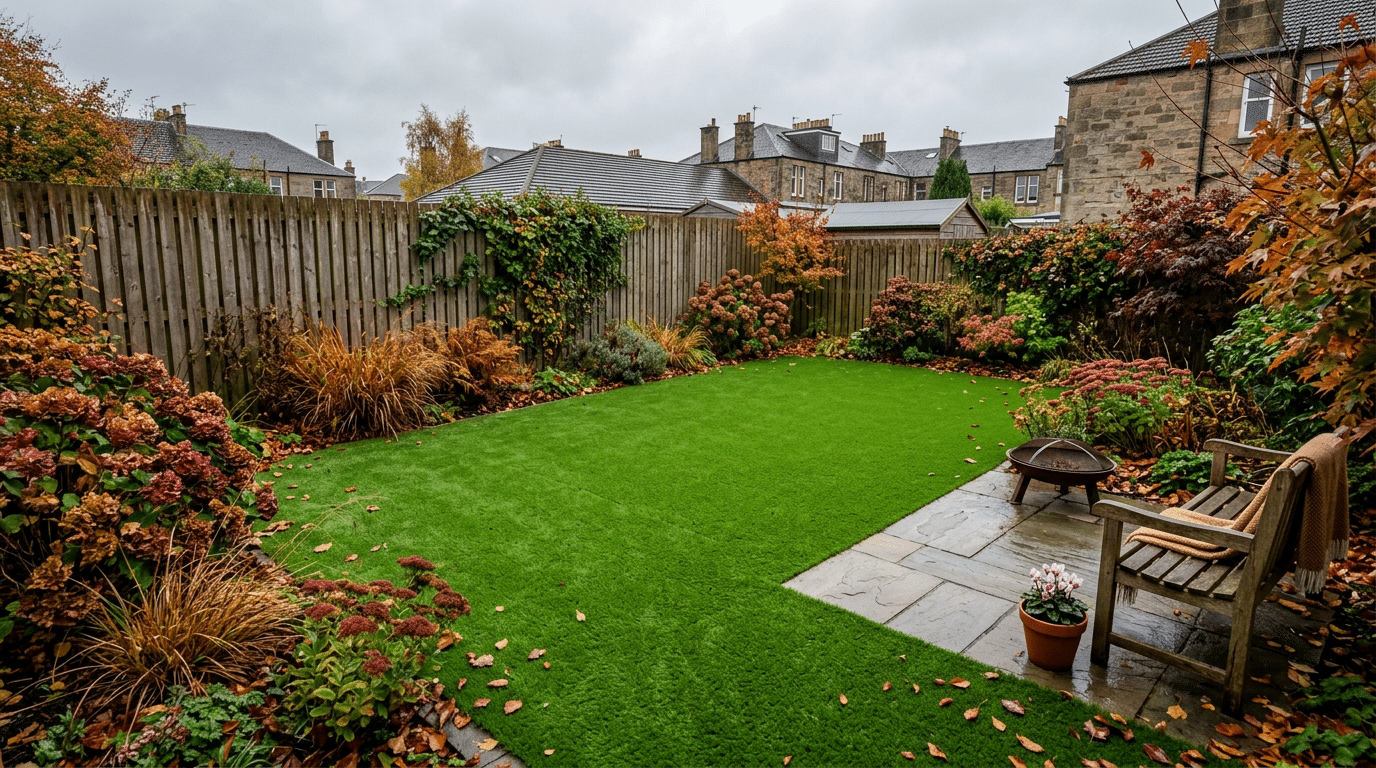

Artificial grass
The maintenance requirements are significantly lighter. Brush the fibres upright every few weeks with a stiff brush, rinse the surface occasionally to remove dust or pollen, and clear fallen leaves before they sit long enough to decompose on the surface.
Weeds can try to creep in at the edges, so it’s worth checking the borders a couple of times a year and dealing with anything that’s taken hold. Outside of that, the list of tasks is short.
There’s no mowing, no feeding, no aerating, and no scarifying. For anyone with mobility issues, a packed schedule, or simply no enthusiasm for lawn maintenance, that difference is meaningful.
Which copes better with Scottish weather?
Scotland’s climate is hard on natural grass. The west of Scotland receives around 1,500mm of rainfall a year, and much of the Central Belt sits on clay-heavy soil that drains slowly.
Clay soil means waterlogged lawns in winter, surface compaction through the wetter months, and moss that establishes faster than it would in drier parts of the UK. The growing season is also shorter here than further south, with fewer hours of sunlight per year. Bare patches in autumn and winter take longer to recover, and heavily shaded gardens (north-facing plots, or those under significant tree canopy) can struggle to maintain grass cover at all.

Common lawn grasses in Scotland, including perennial ryegrass and fescues, do tolerate the climate reasonably well when conditions are right. The problem is that conditions in a typical Glasgow garden are rarely ideal: partial shade, compacted clay, and prolonged wet periods through autumn and winter create ongoing challenges that take regular work to manage.
Artificial grass handles all of this without issue. It drains through the permeable backing and prepared sub-base, so there’s no puddling, no mud, and no worn surface during wet months. North-facing gardens and those under tree cover, where natural grass genuinely struggles to establish, often work particularly well with a synthetic lawn.
There is one caveat worth mentioning. Artificial grass absorbs heat, and on the warmest summer days (rarer in Scotland but not unheard of) a synthetic surface gets noticeably hotter than natural turf. That’s worth knowing if young children play barefoot in the garden during hot weather, and a quick rinse with a hose deals with it easily enough.
What about the environmental impact?
This is the question that splits opinion most sharply, and it deserves an honest answer rather than one that suits whichever side of the argument is being promoted.
Natural grass supports insects, earthworms, and soil microbes. It absorbs carbon, filters rainfall, and keeps the ground beneath it alive and active. A healthy lawn contributes to local biodiversity in ways that synthetic turf simply cannot replicate. That’s a genuine advantage, not a minor consideration.
But maintaining a pristine natural lawn also carries environmental costs. Petrol mowers emit CO2, synthetic fertilisers can leach nitrogen into waterways, and herbicides affect far more than the weeds you’re targeting. The lawn that looks immaculate in August doesn’t get there without inputs of chemicals and fuel.
Artificial grass eliminates the need for watering, chemicals, and fuel-powered equipment. The drawback is that synthetic fibres shed microplastics into soil and water over time, and at the end of its 15 to 20-year lifespan, the product goes to landfill rather than composting back into the ground.
There’s also a drainage consideration worth knowing about. A properly installed artificial lawn with a permeable sub-base drains well, but a poorly laid installation (or one placed over solid concrete without drainage provisions) can contribute to surface water runoff.
Some councils in England and Wales have introduced restrictions on artificial grass in front gardens for this reason. Scotland has no such restrictions at the time of writing, but it’s a good reason to ensure any installation uses a correctly prepared sub-base rather than cutting corners on groundwork.
Neither option is without environmental impact. If supporting wildlife and biodiversity matters most to you, a well-managed natural lawn is the better choice. If reducing chemical use and fuel emissions is the priority, artificial grass has a reasonable case to make.
Which is better for pets and children?
Artificial grass handles dogs well in most respects. Urine drains through the permeable backing rather than pooling on the surface, so it doesn’t create the dead yellow patches that dog urine reliably leaves on natural grass. Solid waste can be lifted and the area rinsed clean.
Most quality products are non-toxic and pet-safe, and the surface is durable enough to cope with energetic dogs without wearing down. It’s a practical choice for anyone whose garden doubles as a dog run for most of the year.
For children, the appeal is a clean, mud-free surface that stays usable throughout the year rather than becoming off-limits from November to March. Artificial grass also removes lawn treatment chemicals from the picture, which some parents find reassuring. The heat consideration on warm days applies to children too, and it’s worth rinsing the surface before outdoor play during particularly hot weather.
Natural turf has its own appeal for children. A garden that’s genuinely alive, where they can dig, find worms, watch bees at work, and have real contact with the natural world, offers something that synthetic grass cannot. That’s not an argument against artificial grass, but it’s a fair point to put on the table.
Which is right for your garden?
For most Glasgow gardens facing north, sitting on clay soil, dealing with regular pet traffic, or owned by people who don’t want to spend their weekends on lawn maintenance, artificial grass tends to be the more practical answer. The upfront cost is higher, but the result is consistent and low-effort across every season.
Natural turf is the better fit if you value biodiversity, if your garden has decent drainage and good light, or if you simply prefer a living lawn. It asks more of you in time and attention, but a well-kept natural lawn in June and July is hard to beat. Some estate agents also argue that a well-maintained natural lawn adds more to a property’s kerb appeal than artificial grass, particularly in premium neighbourhoods where buyers expect real gardens.
The honest position for most Central Scotland homeowners is that artificial grass removes a long list of recurring frustrations and gives you a garden you can actually use in February, not just August. Whether that trade-off is right for you comes down to what you want from your outdoor space.
If you’re thinking about a garden makeover and want advice from someone who installs both, we’ll give you a straight answer about what suits your space. There’s no pressure to go one way, just an honest assessment based on what we see in your garden.
Get your free garden consultation
We offer free consultations across Glasgow, Lanarkshire, and Central Scotland. Whether you’re leaning towards artificial grass, natural turf, or want to combine lawn with a low maintenance garden design, our team can walk your space with you and give a clear, no-obligation quote.
We’re Scotland’s award-winning landscaping company, and we’re here to make your garden work for you. Call us on 07946 322717 or book your free consultation online. Our full landscaping service across the Central Belt covers everything from lawns and planting to patios, driveways, and garden structures.